
CRM technical debt: the silent tax on revenue.
Every shortcut in your CRM keeps charging you long after the sprint that created it. This is how the debt builds, how it shows up in your numbers, and how you pay it down without a rip and replace.
10min read · by the APX team
Debt compounds. Quietly.
Technical debt in a CRM works like compounding interest. The quick fix is the principal: a hardcoded workflow, a field bolted on for one campaign, an integration held together in a hurry. The interest is everything built on top of it afterwards, because every new piece has to work around the last shortcut.
For the first years nobody notices. The system still works. But each change gets a little slower, each report needs one more caveat, and one day the platform that was supposed to accelerate your revenue is the thing slowing it down. The tax was always being charged. It just never appeared on an invoice.
Anatomy of a shortcut.
One hardcoded discount field, followed for four years. Every step felt reasonable at the time. That is the trap.
Day 1
The shortcut
A discount approval workflow hardcodes the region logic into one field. The launch date holds, and everyone moves on.
Principal: two hours of build time saved.
Month 6
The first dependents
Three new workflows and a report filter reference the field, because it is already there. Nobody writes any of this down.
Interest begins: every change must know the quirk.
Year 2
The workaround layer
The field can no longer be renamed safely. A new integration maps around it, and reporting keeps a manual exception list.
Interest compounds: ~20% overhead on every build.
Year 4
Untouchable
The person who built it is gone. Nobody can say what breaks, so the pricing revamp is quoted in months, not weeks.
The balloon payment: three weeks of work, priced at three months.
Multiply this by every shortcut taken since go-live. That is your balance.
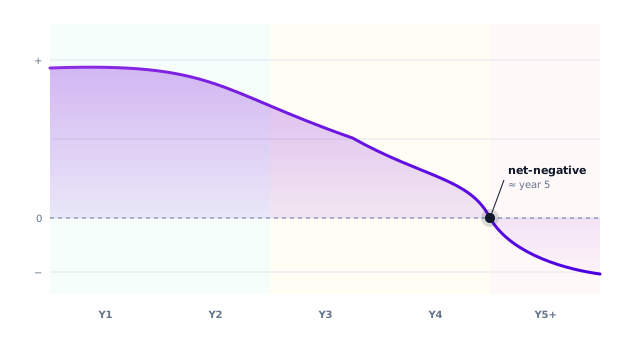
The decay is predictable.
Most CRM failures are not caused by bad tools or bad teams. They follow the same curve, and the inflection point is visible years before the system breaks.
Years 1–2
The honeymoon
Everything is fast. Standard features do the job, changes ship in days, and complexity is low. This is the platform everyone remembers when they defend it later.
Risk: low
Years 3–4
The inflection point
Complexity starts to bite. Deployments slow down, and you start hearing "we can't do that" from your own team. This is the window where you either pay the debt down or let it own the roadmap.
Risk: rising
Year 5+
The ceiling
Innovation stops. The system breaks under its own weight, and the standard advice becomes a full re-implementation. It does not have to. Surgical refactoring recovers most platforms.
Risk: severe
How the tax shows up day to day.
None of these feel like a technical problem when they happen. All of them are. Keep count as you read.
Stalled deals
Pricing takes days, reps route around the system, and momentum dies in a queue.
Forecasts nobody trusts
Duplicates and dead records feed dashboards that stopped matching reality.
Strategic gridlock
A simple field change takes weeks because nobody knows what it will break.
Slow rep ramp
Cluttered screens and legacy fields stretch onboarding past three months.
Governance decay
Profiles and permissions nobody can explain, a compliance finding in waiting.
Field friction
Pages time out on mobile, so field teams quietly stop using the system.
Leads that vanish
Silent integration failures drop marketing leads before sales ever sees them.
Quarter-end freeze
Performance collapses in exactly the 48 hours you need it most.
Now count the ones you recognised.
An honest tally is the fastest CRM assessment you will ever run.
Normal wear
Debt is cheapest to remove while it is small. An annual audit keeps it that way.
The catch window
You are at the inflection point. Paydown is still measured in weeks, and it will never be this cheap again.
Debt owns the roadmap
The system now decides what ships. Recovery starts with evidence, not with another workaround.
What paying it down is worth.
More productive teams
Removing process debt gives reps their selling time back instead of feeding the system.
More accurate forecasts
Unified, deduped data turns the forecast from a negotiation back into a number.
Cheaper than replacing
Preventative architecture costs a fraction of a rip and replace, and keeps your history.
Debt is measured in euros, not opinions.
The Technical Health Audit is five days inside your stack: every shortcut found, every finding priced, and a paydown plan ordered by revenue impact, not by what is easiest to fix. It is how every APX engagement starts.